My friend shared this really terrific video that talks a bit about how octopus and squid camouflage themselves by changing their skin color AND texture. It is astounding how much the octopus in the video blended into the bush. What an amazing world we live in!
Showing posts with label Ocean Unit. Show all posts
Showing posts with label Ocean Unit. Show all posts
Wednesday, September 14, 2011

Saturday, September 3, 2011
Ocean Unit (printables for preschoolers)
2 Teaching Mommies shared this wonderful ocean unit for preschoolers with lots of printable activities. I'll be printing some of these out for ED as we wrap up our ocean unit this next week !
Thursday, September 1, 2011
Ocean Activities - diorama

We made the starfish, sand dollars, crabs and coral out of cornstarch clay.
1 cup cornstarch
1 cup baking soda
1/2 tablespoon salt
1 cup water
Mix and cook on low to medium in a pot until it congeals together.
Tuesday, August 30, 2011
Starting Our New Routine
Sorry about the endless postings about our ocean unit... just a couple more and that's that! Blogs are funny because they sure don't show the whole picture. From looking at our blog our days are consumed by oceans!! Heh heh! Well, that's not at all accurate. I read and read, planned and planned and finally the older kids started back to school last week. As you've seen, ED has been "in school" for a couple of weeks now. That was brilliant because she has a pretty good understanding of her 'work' and has chosen her own work to do while I'm busy with the others. Today, for example... she utterly shocked me by spending AN HOUR doing the push pin drawings I set out two weeks ago (which she said then were too hard!). I had a pile of 25 or so since DD often likes to do them as well. She did them ALL!!!
 Okay -- so back for a moment to DD and LD's new school routine. I decided that we'd have a three hour work session in the mornings. I start with "collection" ... which many people refer to as circle time. Since I have so many things to introduce them to as we start the school year, it's been longer than it will be normally. Here's how collection is going for us at the moment:
Now ideally, I'll do just one presentation, but the first week I had to introduced our various units so the kids know where things were kept and what they could start working on independently. If you've read through my planning stuff the past month or so, you know that our main units this semester or so include...
 So the presentations last week included:
*Let's Learn About the World (basic facts about the largest continent, country, mountain, etc.)
*A discussion of ocean invertebrates (Mollusks-Crustaceans, Echinoderms, Cnidaria) See pic below.
*A few of the landmarks in the US (looking at the cards) and discussion of the southwest
But the presentations led to their own work... drawings, notebook work, read aloud time, etc.
 Here are some invertebrate cards I made to go along with our discussion. Remember, crustaceans, arachnids and insects are all part of the arthropod group (look at this chart to see what I mean). This is not a complete list of invertebrate groups, just some of the ones we have been discussing.
What will the kids do after collection during our school session? Well, this is the hardest part for me. I've been reading a lot (I mean a dozen books!!!!) On the Montessori method and a fabulous book about motivation Drive, The Surprising Truth about What Motivates Us. I really am solidly convinced that the kids need to have the autonomy and independence to direct their own learning. So, I'm trying to create an environment that sets forth lots of learning materials, but I'm trying to step back just a bit to be more of a facilitator than a teacher. I'll obviously be in the room with them at all times (no phone, no Internet), but I'd like to give them more freedom to choose how and what to work on. Stepping back a bit is quite difficult for me since I am a very hands on type person. I hope that by presenting things and then leaving them with lots of choices and options. As I see it that choice may be... "Mom, let's do xyz" or "Mom, let's read together" etc. so very likely at this age I will be involved, but hopefully they will initiate things and they'll embrace the things that interest and intrigue them and learn lots this next year. I am needed for many things --for example, DD is learning the piano for the first time this year so I need to be right there with her for that. Or, LD needs me to sit/read through his math text with him before doing the problem sets on his own. But I am at least cognizant of the fact that my role is to suggest, but never to nag or over-direct/demand. No nagging. There, I've laid it out!!!
One thing I have to say about this past week is that I had to end the school day because *I* had other things on!! So far so good! We went well over three hours each day since we leapt back into things straight after lunch as well.
Well, I'll bring this post to a close for now. We sure have had a fantastic week though (plus it included our first field 'official' field trip... the first of quite a few this semester, we hope!).
Happy Homeschooling! More soon!

- Join together
- German -- greetings, hello, how are you, review of the numbers and saying the numbers without counting (seeing the symbol 8, saying "acht"). German Reader (short, cute, easy stories with cute graphics).
- Calendar time -- change out the "yesterday, today, tomorrow cards." Check the sky and add the appropriate cloud card. Write their name, day and date in their collection notebooks. Check the outside thermometer and record the temperature in C and F.
- Song -- We started with Head, Shoulders Knees and Toes in order to include ED (and to be silly together!)
- Rules for our Homeschool Session (each of us shared one rule to write down, adding to the list each day)
- Presentation
- Write their daily plans in their collection notebooks (I have a list of ideas of things they can work on... some are 'must dos' like math and language arts, but they have a half-dozen things they can do in each of the various categories.)
Now ideally, I'll do just one presentation, but the first week I had to introduced our various units so the kids know where things were kept and what they could start working on independently. If you've read through my planning stuff the past month or so, you know that our main units this semester or so include...
- The Montessori Great Lessons (the first two)
- This is the USA (an introduction to the symbols and landmarks of the US, basic US geography)
- The Human Body (using this and these kits as our core)
- Animal Discovery Notebook (Science Sorts)
- Landforms
- and will also include material to go along with ED's preschool themes (oceans, deserts, rainforests, etc.)
- My husband and I also want to include a presentation each week on Health and Safety. We brainstormed together on our long drive from Missouri and decided that we should cover topics like our phone number, address, emergencies, fire/fire safety/using a fire extinguisher/fire do's/don'ts/stop-drop-roll, being lost in the woods, germs, teeth-care, strangers, general first-aid how-to/whys of cuts, broken bones, etc.

*Let's Learn About the World (basic facts about the largest continent, country, mountain, etc.)
*A discussion of ocean invertebrates (Mollusks-Crustaceans, Echinoderms, Cnidaria) See pic below.
*A few of the landmarks in the US (looking at the cards) and discussion of the southwest
But the presentations led to their own work... drawings, notebook work, read aloud time, etc.
 |
| You can find classification charts on the kingdoms, vertebrates and invertebrates, etc. here and on invertebrates here, arthropods here. We used all those and then drew one together as we talked about it. |

What will the kids do after collection during our school session? Well, this is the hardest part for me. I've been reading a lot (I mean a dozen books!!!!) On the Montessori method and a fabulous book about motivation Drive, The Surprising Truth about What Motivates Us. I really am solidly convinced that the kids need to have the autonomy and independence to direct their own learning. So, I'm trying to create an environment that sets forth lots of learning materials, but I'm trying to step back just a bit to be more of a facilitator than a teacher. I'll obviously be in the room with them at all times (no phone, no Internet), but I'd like to give them more freedom to choose how and what to work on. Stepping back a bit is quite difficult for me since I am a very hands on type person. I hope that by presenting things and then leaving them with lots of choices and options. As I see it that choice may be... "Mom, let's do xyz" or "Mom, let's read together" etc. so very likely at this age I will be involved, but hopefully they will initiate things and they'll embrace the things that interest and intrigue them and learn lots this next year. I am needed for many things --for example, DD is learning the piano for the first time this year so I need to be right there with her for that. Or, LD needs me to sit/read through his math text with him before doing the problem sets on his own. But I am at least cognizant of the fact that my role is to suggest, but never to nag or over-direct/demand. No nagging. There, I've laid it out!!!
One thing I have to say about this past week is that I had to end the school day because *I* had other things on!! So far so good! We went well over three hours each day since we leapt back into things straight after lunch as well.
Well, I'll bring this post to a close for now. We sure have had a fantastic week though (plus it included our first field 'official' field trip... the first of quite a few this semester, we hope!).
Happy Homeschooling! More soon!
Monday, August 29, 2011
Ocean Animals -- the real deal
 Even though it was quite a drive for us, I decided a trip to the aquarium was in order with all our studies of ocean animals. We went last week. We sure had a terrific day!
 |
| We all LOVED the jellyfish displays! |

 |
| We were so lucky to see the octopus moving all around! |


 |
| Everyone loved the sharks and we were lucky to see the sharks, sting rays and sea turtle being fed. |
 |
| We even squeezed in the dolphin show. |

Thursday, August 25, 2011
Ocean Animals and Their Groups

You might want to make a colored circle on the back of each of the three related cards. Use a different color for each animal. That way, the kids can check their own work as needed. Natasha shared this great idea with us at her blog, Leptir.
Wednesday, August 24, 2011
Sewing Ocean Animals

DD made the octopus. LD made the jellyfish. ED made the fish. DD and LD did the sewing completely on their own, although I threaded the embroidery thread through for the tentacles and LD did the knotting. I had to show ED where to place the needle. She only stabbed me once!


Tuesday, August 23, 2011
Ocean Activities: School of Fish
Why do fish swim in schools?

We cut up little pieces of tin foil and paper to be our fish. First we dropped in one and stirred the water. It was easy to spot. Then we dropped in a whole lot of fish, stirred it, and tried to follow just one with our eyes. It was much harder to follow one in the midst of many others. We talked about how there was safety in numbers.
This idea was adapted from Awesome Ocean Science by Cindy Littlefield. She suggests using glitter.
We went on to do a lot with this ocean unit. Be sure to check out this post at our new location, homeschoolden.com:
Some of our activities included:


We cut up little pieces of tin foil and paper to be our fish. First we dropped in one and stirred the water. It was easy to spot. Then we dropped in a whole lot of fish, stirred it, and tried to follow just one with our eyes. It was much harder to follow one in the midst of many others. We talked about how there was safety in numbers.
This idea was adapted from Awesome Ocean Science by Cindy Littlefield. She suggests using glitter.
We went on to do a lot with this ocean unit. Be sure to check out this post at our new location, homeschoolden.com:
Ocean Unit Activities for Kids
Some of our activities included:
UPDATE, 2016: We are doing a unit on the Ocean again. You might be interested in these posts (I'll try to add to the list as we go!) :) ~Liesl

- Ocean Unit: 5 Salinity Experiments and Why the Ocean is Salty
- Surface Currents vs. Deep Sea Currents - More Fun Hands-On Ocean Activities!
- Water Cycle Review: Divides and Watersheds, Aquifers, Ocean Drainage
- Oceans, Seas, Straits: Free Pin Map Printable
- Ocean Zones
Monday, August 22, 2011
Ocean Animals Math Game for Preschoolers

It's a short, quick counting game and we played over and over again! Below are a few more photos and a link to the game if you want to download it for yourself.
Math Grid Game: By the way, you can also use the ocean animal sheet to play a simple math grid game. Keep the animal sheet intact and print out one sheet for each player. Have each player take turns rolling the die and covering up that number of animals. The first person to cover all the animals wins that game.

Download the Ocean Animals Preschool Game Here.
You can also use these cards with your kids to sort into vertebrate and invertebrate groups.
You can also use these cards with your kids to sort into vertebrate and invertebrate groups.

To Play:
Player 1 rolls the die. He/she takes that number of ocean animals and places it on his/her game board.
Player 2 rolls the die and takes that number of ocean animals to place on his/her game board.
One player spins the spinner to determine the winner -- the one who has less, more, odd or even. You may have two winners!
Thursday, August 18, 2011
Ocean Activities: The Ocean Zones


The
ocean is divided into different layers. The zones differ in temperature, water pressure and available
nutrients. Marine organisms live in
different zones according to the amount of sunlight that reaches there. More than 90% of marine life lives in the Sunlit Zone.
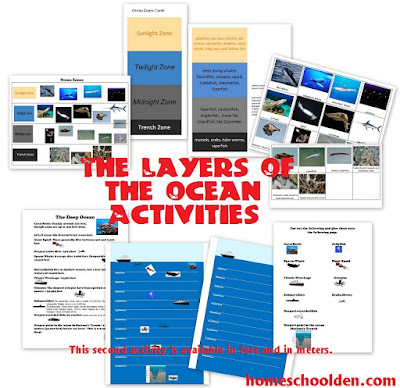
 I made cards of the various ocean zones for the kids, cut them out and laminated them together.
 I made cards of the various ocean zones for the kids, cut them out and laminated them together.
This is a picture of the original activity I made for the kids, but I couldn't share it publicly because I wasn't sure of the copyright status of some of the pictures I used.
Recently, I made new animal sorting cards for the ocean zones and that is now available. The pictures I used for this new packet were either purchased (from canstockphoto.com) or have a creative commons license.
Here is more about the new activity packet I made:
Animals of the different Ocean Zone Layers:
- Sunlight Zone - Blue Marlin, Sperm Whale, Grey Reef Shark, Plankton, plankton, sea stars, jellyfish, sea urchins, sea turtles, dolphins, seals, sharks, sting rays, sand dollars, fish
- Twilight Zone - Octopus, Squid, Deep diving whales, Hatchetfish, Viperfish, Cuttlefish, deep diving whales
- Midnight Zone - Angler Fish, Snipe Eel, Lizard Fish, Sea Cucumber, Lanternfish, Sea Cucumber
- Trench Zone - mussels, crabs, tube worms, viperfish

Layers of the Ocean Activity Packet: There are two Ocean Zone Activities. It includes the ocean animal sorting cards and zone cards that you see above. And it also includes an Ocean Depths activity, which covers things like--how deep was the deepest scuba dive, the Titanic wreckage, the deepest recorded fish, or how far down is the Mariana Trench. Students can cut out pictures of these and place them at the appropriate depth. (Also in the packet, you'll find this same activity in meters.)
The Ocean Zones Activity Packet is available for $3.00.

More Ocean Curriculum...
Ocean Packet: We have been studying the Ocean again in the spring of 2016. Our 65+ page Ocean Unit (see details about our ocean worksheets and materials here) is now available!
- Ocean Unit: Marine Habitats, water form words (bay, strait, fjord,
etc.), tides and currents, salinity, features of the ocean floor, Ocean
Life:
- Special Body Features
- Fish Body Shape and Movement
- Biological Interactions: Mutualism and Commensalism in the Ocean
- Deep Sea Life – Bioluminescence, Anglerfish
BUNDLE: Ocean Unit Packet AND Layers of the Ocean Activities Packet (above)
$8.00
Don't forget to check your PayPal email address for the download link!

Here are some of our other ocean materials:
Ocean Unit Activities for Kids
Some of our activities included:
Wednesday, August 17, 2011
Ocean Activities: Parts of a Fish, Parts of a Shark

 While ED has some basic ocean matching out, DD and LD are working on slightly more challenging work. They're learning the parts of the fish, parts of the shark and the zones of the ocean and the animals that live there. (More about the zones tomorrow.)
  |
| The kids can check their work by folding down the answer key under the picture. I got the parts of the fish page from Simple Schooling at currclick. (The unit is on sale at the moment for 50% off.) |
 |
| The parts of a shark was from Ask a Biologist. |
Friday, August 12, 2011
Preschool Routine, Tuesdays
ED's Tuesday Routine:
So you heard yesterday that I'm planning to use biome/habitat themes with ED this fall. This is what I have planned in a general way for Tuesdays:
Arts and Crafts (based on the theme)
Montessori Math Beads; Math Activities
Science Sorts (Long post and link to my 30-pages of notes, etc.!)
Arts and Crafts

Montessori Math Beads:
I have Tuesdays set aside to bring out the Montessori math beads and work with ED on some basic number skills.
I think this might be called the "Bead Stair" in Montessori circles. I simply cut out two triangles from felt (so the beads won't roll off) and set out the appropriate beads (we're using 1 to 6 this week). The triangle helps create a control so that the child can visually see the progression.

 This week I also set out a jellyfish number matching activity and our number puzzle.

Science Sorts:
Living-Non Living Cards
More about our science sorts this fall at this post.
So you heard yesterday that I'm planning to use biome/habitat themes with ED this fall. This is what I have planned in a general way for Tuesdays:
Arts and Crafts (based on the theme)
Montessori Math Beads; Math Activities
Science Sorts (Long post and link to my 30-pages of notes, etc.!)
Arts and Crafts
 |
| The girls painted boxes to make a diorama. |
 |
| Now all this needs is the sea creatures! |
 |
| The kids have had a blast making various sea creatures. They made fish, jelly fish and sharks for nearly two hours! I found an amazing set of ocean craft ideas over at Playing House in Maryland. |

Montessori Math Beads:
I have Tuesdays set aside to bring out the Montessori math beads and work with ED on some basic number skills.
I think this might be called the "Bead Stair" in Montessori circles. I simply cut out two triangles from felt (so the beads won't roll off) and set out the appropriate beads (we're using 1 to 6 this week). The triangle helps create a control so that the child can visually see the progression.


Science Sorts:
Living-Non Living Cards
 |
| I printed out this free card set from Homemade Montessori. They have gotten a lot of use these past few years. |
Subscribe to:
Posts (Atom)